Home › Recipes › Dairy

Firm Cheese in Salty Brine

firm cheese in salty brine

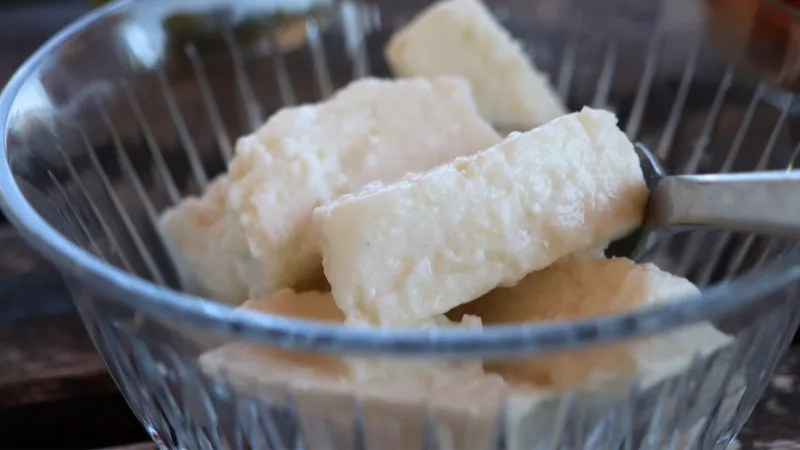
This firm cheese in brine is a simple homemade cheese: milk heated to 82 °C, set with yoghurt and lemon juice, drained, pressed overnight, then cubed and cured in its own whey with 2% salt. The brine preserves the cheese and gives it a savoury, feta-like tang. It takes about 30 minutes of hands-on time, then pressing and 2 days to 2 weeks in the brine.

PREP

30 min (+1 h draining, 6 h+ pressing)

COOK

2 days–2 weeks curing in brine

TOTAL

2 days–2 weeks

SERVES

about 500 g (1.1 lb) cheese

DIFFICULTY

Medium

Why this recipe works

firm cheese in salty brine

Firm Cheese in Salty Brine

A homemade lemon-set cheese, pressed, cubed and cured in salted whey.
Prep Time 30 minutes
Draining & pressing (1 h + 6 h or overnight) 7 hours
Total Time 7 hours 30 minutes
Servings: 500 g (1.1 lb) cheese
Course: Dairy
Cuisine: Mediterranean

Ingredients
  

For the cheese
  • 5 L (1.3 gallons) milk
  • 100 ml (3.4 fl oz) full-fat yoghurt
  • 150 ml (5 fl oz) fresh lemon juice
For the brine
  • 1 L (34 fl oz) whey from the cheesemaking
  • 20 g (0.7 oz) salt sea or kosher salt, 2% of the whey

Equipment

  • Large pan
  • Thermometer
  • Wooden spoon and ladle
  • Strainer and cheesecloth
  • String
  • Cheese mould
  • Sushi mat or mesh, rack and baking tray
  • Weight for pressing
  • 1 L (1 quart) clean jar

Method
 

  1. Heat the milk to 82 °C (180 °F), stirring gently so it doesn't stick.
  2. Take the pan off the heat and stir in the yoghurt.
  3. Add the lemon juice and return to the heat for 5 minutes, stirring only now and then, until the curds separate from the whey.
  4. Turn off the heat and set aside 1 litre of whey in the fridge for the brine.
  5. Line a strainer with cheesecloth over a pan and ladle in the curds and whey.
  6. Press the curds in the cloth to squeeze out more whey, tie the cloth with string and hang it for about 1 hour.
  7. Put the curd ball into a cheese mould on a mesh (a sushi mat on a rack over a tray).
  8. Put something flat on top, weigh it down and press for at least 6 hours, ideally overnight.
  9. Stir the salt into the reserved litre of whey until completely dissolved.
  10. Cut the cheese into 1 cm (½ in) cubes and pack them into a sterilised jar.
  11. Cover completely with the salted whey and keep in the fridge for 2 weeks before eating.
Notes

  • Keeps 2–4 weeks in the fridge, as long as the cheese stays fully submerged.
  • Check for off smells, mould or texture changes before eating.
  • Curing in the brine: 2 days to 2 weeks; we wait 2 weeks.
  • Best on salads or toast.

Tips for cheese in brine

Using lemon juice to curdle milk

Lemon juice lowers the pH of hot milk so the proteins coagulate into curds. It’s the same principle behind paneer and ricotta.

Brine for cheese: get the salt right

Use 2% salt by weight of whey: 20 g salt per litre. Stir until fully dissolved before pouring it over.

Keep it submerged

Any cheese poking out of the brine can spoil. Top up with a little extra salted whey if needed.

How to serve it

Crumbled over salads, on toast, or simply on its own.

Cheese in brine: FAQ

What is brine cheese?

Brine cheese is cheese that’s stored and cured in salty liquid. Feta is the best-known example, and many cheeses from the Mediterranean, the Balkans and the Middle East are kept the same way. The brine works as a natural preservative, holding back unwanted bacteria and mould, and it seasons the cheese from the outside in, giving it a savoury, slightly tangy flavour and a firmer texture over time.

What brine do you use to store cheese?

We make the brine from the whey left over from making the cheese, with 2% salt by weight: 20 g of salt per litre of whey. Sea salt or kosher salt is best. Stir until the salt has completely dissolved before you pour it over the cubed cheese. Using whey rather than plain water helps keep the surface of the cheese from going soft, and it uses up a by-product that would otherwise go to waste.

How long does cheese keep in brine?

Kept in the fridge and fully submerged, it keeps for 2 to 4 weeks. We let it cure for 2 weeks before eating, as the texture firms up and the flavour deepens. Any cheese that pokes out of the brine can spoil, so keep it covered. Always check for off smells, mould or a slimy texture before eating, and use a clean spoon or fork to take cubes out.

Can you make cheese with lemon juice instead of rennet?

Yes. Heating milk to about 82 °C (180 °F) and adding an acid such as lemon juice makes the milk proteins (mainly casein) clump together into curds, leaving the liquid whey behind. It’s the same principle used for paneer and ricotta. An acid-set curd is soft on its own, so we drain it in cheesecloth and then press it in a mould for at least 6 hours to make a cheese firm enough to cut into cubes.

You might also like

More: all dairy

Cook it with us on the farm

Watching milk turn into curds, then into a cheese you’ll eat a week later, never stops feeling like a little bit of farm magic. At our retreats here in Portugal we harvest, cook and eat together around the farm table, and you go home with the confidence to make recipes like this your own. We would love to cook with you.

Join our farm newsletter

Seasonal recipes from our fields, plus exclusive subscriber discounts, including on our retreats.

Great, you’re almost in! 🎉

Please check your inbox and click the link to confirm your email address. 

If you don’t see it within a few minutes, CHECK YOUR SPAM OR PROMOTIONS FOLDER.


We’ll be in touch soon!

YES!
SIGN ME
UP

When you join, we will send you bimonthly updates
from the farm, as well as any new recipes we share with our community before they hit youtube!

ONLY newsletter members get our early bird DISCOUNTS for our courses, retreats and more!

JOIN OUR NEWSLETTER!

ONLY newsletter members get NEW recipes first, our early bird DISCOUNTS and an occasional inside peek into what is happening before it hits youtube!